Sunday, September 7, 2014

Blog #18: Hamlet

Due Date: Saturday, September 20 and the end of the day.
Minimum Word Count: 450
Minimum Quotations and Specific Text References: 4
Please come up with a better title than "Hamlet" and start with a strong thesis or claim.

Your task:


You've been working on this blog post for the past week. It's based on the essential question that fate selected for you. If you need a reminder about your question or a copy of the outline sheet that you got in class, click here.

Throughout the process of reading, discussing, and writing about the play, you followed and took notes on your essential question. Now, this is your opportunity to present your reflections, discoveries, and conclusions in the form of a blog post, complete with textual citations and quotations (required) and multimedia (when appropriate).

You must incorporate at least two relevant quotes from the play, as well as paraphrased instances from Hamlet or other texts that relate to your thinking (between 4-8) that support your answer. You might also consider using minor supporting information from other sources (allusions to historical figures, celebrities, the Bible, or other stories/films). If you allude to anything other than the play itself, be sure it is cited correctly to credit is given to the original authors.

Here's how you cite examples and lines from the play:


25. Verse play or poem For verse plays, give act, scene, and line numbers that can be located in any edition of the work. Use arabic numerals and separate the numbers with periods.
In Shakespeare’s King Lear, Gloucester, blinded for suspected treason, learns a profound lesson from his tragic experience: “A man may see how this world goes / with no eyes” (4.6.148-49).

Thursday, August 21, 2014

Blog #17: What is justice?

Due Date: Sunday, September 8
Minimum Word Count: At least 350
At least 1 quote or reference to Plato's The Republic
At least 1 quote, reference, or link to a modern example of justice or injustice


The first week of class has focused on two main questions:

Why bother being good?
What is Justice?

These questions have sparked a lot of thought, discussion, and debate. Most of all, they've called into question some of the essential questions about what it means to be a part of a culture or civilization.

For your first blog, take time to come to some conclusions for yourself on the issues of goodness and justice. Here are some possible questions to get your started, but you are always more than welcome to come up with a question or questions on your own.


What is justice?

Is justice, as it is currently practiced, just the advantage of the stronger? How do you know?

Why do you think our discussion on the importance of doing good turned into a discussion on the benefits of being bad?

How is the ideal of justice different from how you have experienced justice?

How do children learn about justice, and what does that say about us?

Look at the current events surrounding Bradley Manning, Edward Snowden, or Trayvon Martin and discuss how you see justice or injustice playing into these situations.

Why bother defending justice?


Our questions from class:


  • What is Justice and how did it change from when The Republic was written and now?
  • Can justice co-exist with other qualities in a person?
  • Is justice still justice when the person delivering the ‘justice’ is ‘unjust’?
  • Can justice be unjust?
  • Who does justice better?
  • Does Socrates really know what justice is and is testing those around him, or is he curious?
  • Can justice be bad but still be justice?
  • Why is justice important?
  • Do you need justice to have a peaceful society?

Monday, June 2, 2014

Blog #16 - Your Year

Reflect on your growth, thinking, and connections you've made throughout this year.

Creating, Non-fiction projects, Truth, Happiness, Nature, Beauty, American Dream, The Good Life, Goodness, Leadership, Meaning, Asking Questions, Choice, Connections, Lenses, Vocabulary, Self as Reader, Satire, Videos, Importance of Story, Research, Experience Points, Fallacies, Claims, Evidence, Warrant, Discussions, Critical writing prompts, creative writing prompts, interviews, lead-transition-quote articles, Julius Caesar, To Kill a Mockingbird, The Stranger, Vonnegut, Animal Farm, Dystopias, Night Flying Woman, American Male Age 10, Hawthorne, Thoreau, Ben Franklin, This American Life, Shoes, Interviews,and a lot more.


Friday, May 16, 2014

Blog #15: Your nonfiction project

Due Date: Sunday, June 1
Minimum Word Count: 500 words

Congratulations, friend! You did it.

You've got your nonfiction project complete and you've shared it with the class. You've put in a lot of time, effort, and energy over the past few months, and you've learned something because of it. Now, it's time to share what you've learned.

This blog has two requirements:

  1. Share your project in some way on here. 

    1. Embed your Prezi or YouTube video.

    2. Upload your podcast to SoundCloud and embed it.

    3. Share your Google Doc with the world and embed or link to it on here. Do something to make your project available to everyone.

  2. Reflect on your project and present your major conclusions and understandings.

If that is enough information for you and you want to take your own spin on this blog, then go for it!

If you still need more, then continue reading.

A good reflection will:

  • An explanation of how you accomplished what you accomplished.

    • Turn our research and findings into a story that raises and answers questions.
    • What are your main findings and what research did you do that led you to those conclusions. What did you learn along the way about your topic? How would you explain your research process in light of your findings?

    • What were your beliefs heading into the project and how did they change throughout your process? What learning, research, observations, or interviews helped you in your thinking?

  • What you think went well with your project.

  • What areas for improvement do you see?

    • Beyond "Start earlier", what would you do differently if you were to do this again?

  • What do you hope your audience would take from your project?

  • What are some thing you learned that you left out of your project?

  • What are some thing you're looking forward to doing with your next research project?

Monday, May 5, 2014

Blog #14: Your Utopia

Due: Friday, May 9
Word Count: 400
Minimum Links or References: Two
Remember to use links to resources to help support your thinking. Your claims should have support.

Your Project


No matter which questions you'll answer, please do this. First of all, embed your video from your group so that other people can see it. Don't just link to it. It should look like this:


Copy your video URL from YouTube, click the clipboard icon on the formatting bar, select YouTube video and paste in the link. Hopefully this will work for you.

  • Describe your Utopia. Give a general description of the society and the process of creating it. What are the fundamental principles behind your Utopia?
After you have your video and a general description for your society posted, consider the following questions:
  • What challenges did your group have in the creation of a Utopian society?
  • What were your group's focus questions? How did you address them?
  • What did this project make you think about in regards to governments or governing people in general?
  • Could people ever create the perfect government or society for themselves or would it be easier for an outside group to create a utopia for someone else?
  • What do believe your Utopia really has gotten right? What things do you think wouldn't work in actuality? Why would your Utopia be successful, why would it fail.
  • Just go in detail about your Utopia: Its principles, how it'll work, how it will incorporate the key elements of a perfect government.

Updated Questions and Thoughts

After you post your video, you can address the questions above or take on some of the deeper questions we tackled in class discussions. See the details below for more clarification.


Self Actualization and Utopias


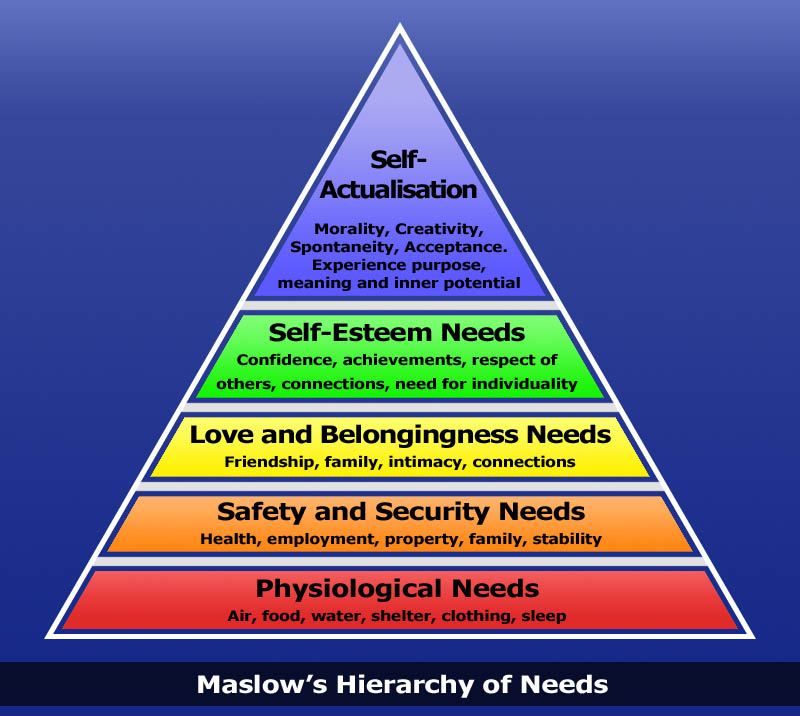
Can a classroom, a family, a government, or a school be set up to help people achieve self-actualization? What would that look like?

Can only self-actualized people help others become self-actualized? If self-actualization was a goal, how could a system be created to help it happen for the most people?

Wants, Needs, and Making Good Decisions

Respond to the following statement: “People are driven by their wants more than their needs, and this makes them incapable of making good decisions about government.” 

Write about the way your thinking on these issues may have developed and how you see these things expressed either in the way the world is currently or the way it works in literature.

The Importance of Wellbeing

Respond and expand on the following statement: “The wellbeing of a society should be more important than the happiness of individual citizens.”

How does this relate to your thinking about Government, Utopias, and Dystopias. Can a great government thrive on this principle? Can people create their own happiness in a government that doesn't consider the happiness of an individual but values the wellbeing of the whole society. Does living in a great place mean sometimes accepting unhappiness or discontent?


Other Thoughts

Here's a link to our discussion questions from throughout the week. If you like one or want to combine several, you can. Please remember to find resources you can use as links to support your thinking.


Tuesday, April 15, 2014

Blog #13: Final Choice Novel blog

Minimum Words: 450
Make sure you are continuously having a conversation with the text, referencing it and responding to it.

This blog should cover the second half of your choice novel (though referencing the first half is obviously okay).

These are the things to consider in your blog:

1. A Reader Response to the novel as a whole. Include your opinions on how your story was resolved, what you liked, what you didn't, discuss predictions you made and how accurate they were (or weren't), etc.

2. Discuss the second half of the book through a different lens than the one you discussed initially. You can still refer to your original lens, but try another one regardless of how much of a stretch it may seem. Make sure to use specific references from the book.

3. Finally to reinforce viewing things from a different perspective... though we describe these books as "dystopian" they are a "utopia" for someone. Take some time to consider who is benefiting from the society created in your novel. How is life for them? What are their goals? Needs? Wants?

Thursday, April 10, 2014

Blog #12: Choice Dystopian Novel

This should be the first blog post for your dystopian choice novel and should cover at least the first half of the book.

The goal for this assignment is to discuss your novel as you would with a regular lit circle; ideas, thoughts, surprises, and questions. Because of the nature of this discussion, it will be less formal than your last post. Also make sure you view your novel through at least one of the critical lenses discussed in class.

Try to move past the Reader Response lens (just your reaction to the text) and try to connect your reactions to something else. Make observations, predictions, compare and contrast, but use a different lens to shape your entry. Remember to constantly refer to the text quoting specific passages and phrases.

400 word minimum, excluding quotes.

If you need them, here are some thoughts that may help get you started:

  • Connection and empathy (or the lack thereof); what kinds of experiences have brought people together (or driven them apart)? How have you seen that develop, and how has it shaped the book?
  • The idea of "progress"; how is it framed? Has it contributed to the "dystopia" created? How?
  • Try on the gender lens; how would something as simple as changing the gender of your main character change the story? Would the conflict be the same? Why? Include the book title in your Post title so they are easier to find for responses. 
Due end of the day Friday, April 11.