Friday, May 16, 2014

Blog #15: Your nonfiction project

Due Date: Sunday, June 1
Minimum Word Count: 500 words

Congratulations, friend! You did it.

You've got your nonfiction project complete and you've shared it with the class. You've put in a lot of time, effort, and energy over the past few months, and you've learned something because of it. Now, it's time to share what you've learned.

This blog has two requirements:

  1. Share your project in some way on here. 

    1. Embed your Prezi or YouTube video.

    2. Upload your podcast to SoundCloud and embed it.

    3. Share your Google Doc with the world and embed or link to it on here. Do something to make your project available to everyone.

  2. Reflect on your project and present your major conclusions and understandings.

If that is enough information for you and you want to take your own spin on this blog, then go for it!

If you still need more, then continue reading.

A good reflection will:

  • An explanation of how you accomplished what you accomplished.

    • Turn our research and findings into a story that raises and answers questions.
    • What are your main findings and what research did you do that led you to those conclusions. What did you learn along the way about your topic? How would you explain your research process in light of your findings?

    • What were your beliefs heading into the project and how did they change throughout your process? What learning, research, observations, or interviews helped you in your thinking?

  • What you think went well with your project.

  • What areas for improvement do you see?

    • Beyond "Start earlier", what would you do differently if you were to do this again?

  • What do you hope your audience would take from your project?

  • What are some thing you learned that you left out of your project?

  • What are some thing you're looking forward to doing with your next research project?

Monday, May 5, 2014

Blog #14: Your Utopia

Due: Friday, May 9
Word Count: 400
Minimum Links or References: Two
Remember to use links to resources to help support your thinking. Your claims should have support.

Your Project


No matter which questions you'll answer, please do this. First of all, embed your video from your group so that other people can see it. Don't just link to it. It should look like this:


Copy your video URL from YouTube, click the clipboard icon on the formatting bar, select YouTube video and paste in the link. Hopefully this will work for you.

  • Describe your Utopia. Give a general description of the society and the process of creating it. What are the fundamental principles behind your Utopia?
After you have your video and a general description for your society posted, consider the following questions:
  • What challenges did your group have in the creation of a Utopian society?
  • What were your group's focus questions? How did you address them?
  • What did this project make you think about in regards to governments or governing people in general?
  • Could people ever create the perfect government or society for themselves or would it be easier for an outside group to create a utopia for someone else?
  • What do believe your Utopia really has gotten right? What things do you think wouldn't work in actuality? Why would your Utopia be successful, why would it fail.
  • Just go in detail about your Utopia: Its principles, how it'll work, how it will incorporate the key elements of a perfect government.

Updated Questions and Thoughts

After you post your video, you can address the questions above or take on some of the deeper questions we tackled in class discussions. See the details below for more clarification.


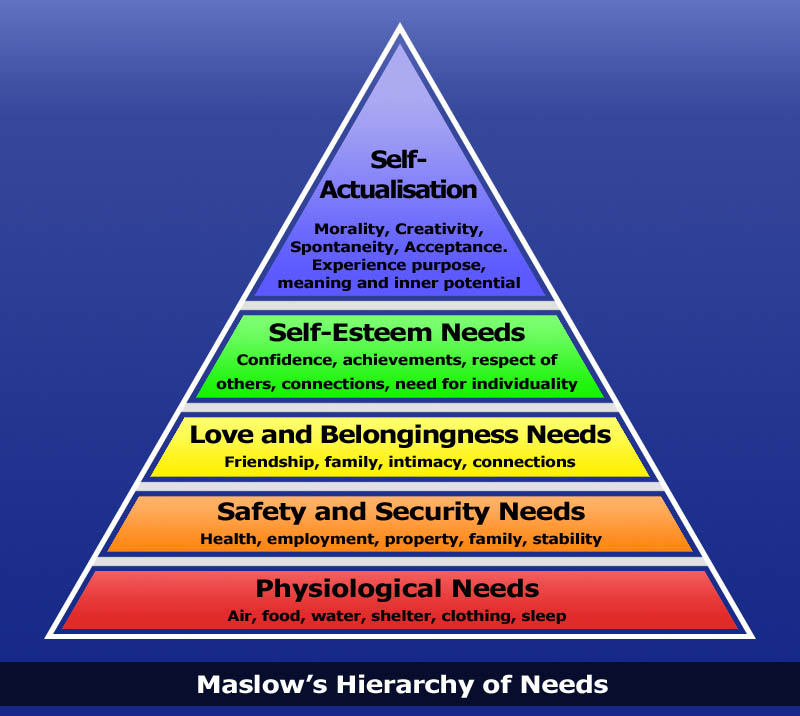
Self Actualization and Utopias


Can a classroom, a family, a government, or a school be set up to help people achieve self-actualization? What would that look like?

Can only self-actualized people help others become self-actualized? If self-actualization was a goal, how could a system be created to help it happen for the most people?

Wants, Needs, and Making Good Decisions

Respond to the following statement: “People are driven by their wants more than their needs, and this makes them incapable of making good decisions about government.” 

Write about the way your thinking on these issues may have developed and how you see these things expressed either in the way the world is currently or the way it works in literature.

The Importance of Wellbeing

Respond and expand on the following statement: “The wellbeing of a society should be more important than the happiness of individual citizens.”

How does this relate to your thinking about Government, Utopias, and Dystopias. Can a great government thrive on this principle? Can people create their own happiness in a government that doesn't consider the happiness of an individual but values the wellbeing of the whole society. Does living in a great place mean sometimes accepting unhappiness or discontent?


Other Thoughts

Here's a link to our discussion questions from throughout the week. If you like one or want to combine several, you can. Please remember to find resources you can use as links to support your thinking.


Tuesday, April 15, 2014

Blog #13: Final Choice Novel blog

Minimum Words: 450
Make sure you are continuously having a conversation with the text, referencing it and responding to it.

This blog should cover the second half of your choice novel (though referencing the first half is obviously okay).

These are the things to consider in your blog:

1. A Reader Response to the novel as a whole. Include your opinions on how your story was resolved, what you liked, what you didn't, discuss predictions you made and how accurate they were (or weren't), etc.

2. Discuss the second half of the book through a different lens than the one you discussed initially. You can still refer to your original lens, but try another one regardless of how much of a stretch it may seem. Make sure to use specific references from the book.

3. Finally to reinforce viewing things from a different perspective... though we describe these books as "dystopian" they are a "utopia" for someone. Take some time to consider who is benefiting from the society created in your novel. How is life for them? What are their goals? Needs? Wants?

Thursday, April 10, 2014

Blog #12: Choice Dystopian Novel

This should be the first blog post for your dystopian choice novel and should cover at least the first half of the book.

The goal for this assignment is to discuss your novel as you would with a regular lit circle; ideas, thoughts, surprises, and questions. Because of the nature of this discussion, it will be less formal than your last post. Also make sure you view your novel through at least one of the critical lenses discussed in class.

Try to move past the Reader Response lens (just your reaction to the text) and try to connect your reactions to something else. Make observations, predictions, compare and contrast, but use a different lens to shape your entry. Remember to constantly refer to the text quoting specific passages and phrases.

400 word minimum, excluding quotes.

If you need them, here are some thoughts that may help get you started:

  • Connection and empathy (or the lack thereof); what kinds of experiences have brought people together (or driven them apart)? How have you seen that develop, and how has it shaped the book?
  • The idea of "progress"; how is it framed? Has it contributed to the "dystopia" created? How?
  • Try on the gender lens; how would something as simple as changing the gender of your main character change the story? Would the conflict be the same? Why? Include the book title in your Post title so they are easier to find for responses. 
Due end of the day Friday, April 11.

Monday, March 31, 2014

Blog #10: Power and Leadership in Julius Caesar

Due Date: Thursday, March 20
Minimum Words: 350
Links required, none
Text references required: 2


For the complete text of Julius Caesar, with both the original text and the modern translation, check out No Fear Shakespeare: Julius Caesar.

Consider the story of Julius Caesar and reference it as you respond to the text. Your response should focus on the ideas of Power and Leadership.


Make sure your writing as a clear claim near the beginning and that you introduce your topic ully. You need to give context to your audience at the start of your writing so they know what you are writing about what you may be trying to prove.


Here are a few questions if you need an idea to get you started. You can go in depth about any of these or combine them into your own questions. Don't treat this as a quiz and answer every questions.

  • What modern connections can you make between Julius Caesar and the idea of leadership today?
  • Antony, another member of that ruling class, is also one of the more sympathetic characters of the play. But is he a good ruler?
  • Does this play portray an ideal leader? Does it give any clues about what an ideal leader could be?
  • What is the difference between a good person and a good leader? Are those two things mutually exclusive in certain ways? Are there ways that good people cannot be good leaders and good leaders cannot fully be good people? What implications does this have on your views of leadership?
  • What kind of leader is Julius Caesar? The conspirators say he's a tyrant headed for absolute power. Is there evidence in the play to support this? Is Caesar really a threat to the Roman Republic? Why or why not?
  • Were the conspirators justified in removing a leader who has the potential to be a tyrant?
  • What relationship is there between leaders and those who are led (or, perhaps, followers)? What does this play suggest about the people's ability to choose leaders and the choices they make for themselves? What do the Plebeians suggest in this play?
  • What connections can you make between "A Good Man is Hard to Find" and Julius Caesar.


Here's how you cite examples and lines from the play:

Although it is not required in this blog entry, you can get tremendous practice in citing text from a play with this blog. You will receive extra credit points for attempting to quote a passage from the play in the correct format.

25. Verse play or poem For verse plays, give act, scene, and line numbers that can be located in any edition of the work. Use arabic numerals and separate the numbers with periods.
In Shakespeare’s King Lear, Gloucester, blinded for suspected treason, learns a profound lesson from his tragic experience: “A man may see how this world goes / with no eyes” (4.6.148-49).


Sunday, March 16, 2014

Blog #11: Animal Farm Reader's Notebook

This entry should cover the end of the book
Due Date:
 Monday, March 31 by the end of class.
Minimum Words: 500 of your own words, not counting quotations.
Note: Be sure you are using a lens and continually returning to the text in quotations. Feel free to refer to class discussions.

Helpful links: Sample Reader's Notebook from CIS Literature* | Critical Lens notecards |  Reading Schedule | Reader's Notebook Instructions | Spark Notes and Penguin Guide | How to do in-text citations right | Historical context of George Orwell and Animal Farm


For this blog, try to move beyond just the reader response lens - just your reactions to the text. Instead, try to connect your reactions to something else, make observations and predictions, comparisons and contrasts, or use a different lens to shape your entry.

The most important thing to remember is that you should constantly refer to the text. Quote passages and paraphrase scenes.

Here are some questions or ideas you can look at to get started if you are stuck. These are not required questions and you can completely ignore them if you'd like:
  • What are the conflicts in Animal Farm? What types of conflict (physical, moral, intellectual, or emotional) do you see in this story?
  • How does George Orwell reveal character in Animal Farm?
  • What is the central/primary purpose of the story? Is the purpose important or meaningful?
___
* The CIS Reader's Notebook is much more thorough and much longer than your notebook needs to be

Monday, February 3, 2014

Blog #9: Claim, Evidence, Warrant

Due: Friday, February 7 at midnight
Minimum words: 400
Minimum links (evidence): 3

Note: This blog entry is worth more than the traditional 25 point blog entry. You will be evaluated by more than one person, including members of the Journalism 2 class at Buffalo High School.

For the past few weeks, we've been talking about Claim, Evidence, and Warrant as a way of presenting an argument. If you're totally baffled by this, check out this helpful site that will walk you through it. Also, this page may be even more helpful with examples.

We're pretty awesome at creating arguable claims, and we're starting to get great at Evidence. Warrant is giving us a headache.

Warrant is the "So what?" It explains why your evidence is important and how your evidence connects to your claim. It makes a claim convincing.

Your task? It's easy.

Choose a topic. It could be the same as your Satire topic, something that can help you with your nonfiction project, or just something you're interested in. Then, you get to engage it with informational writing using Claim - Evidence - Warrant.

  1. Make an arguable claim that you actually believe.

  2. Provide valid evidence for your claim from authoritative sources and link to that evidence.

  3. Provide warrant.

  4. Anticipate a counter-claim and briefly argue against it, explaining how your argument is better through evidence and warrant.
I ask that you make a claim that you actually believe in or one that you actually can support. Remember that an arguable claim is one that can be debated, so go ahead and pick something that not everyone agrees with you about.

Your writing should be polished and your evidence should be sound. You should put emphasis on proofreading your entry and work toward having a clear and audience-friendly final draft.

Need help? Try it first!